When the Aisles Go Quiet: The Case for a Phone-Free Ceremony
The New Etiquette of Attention
A wedding ceremony is one of the few remaining public rituals in American life where a room full of people is expected to do nothing but watch. Yet for the better part of a decade, guests have watched through screens. The result is a paradox: more images than ever, and fewer photographs of people actually looking. The unplugged ceremony — a polite request that guests silence and pocket their phones for the duration of the vows — has moved from eccentric to commonplace. In 2026 it is less a trend than a correction.
This is not an argument against technology. It is an argument about attention. When a couple asks guests to put phones away, they are not asking for a performance of reverence. They are asking for the conditions under which reverence happens on its own.
What the Camera Sees When the Screens Go Down
The photographic difference is immediate and structural. A raised phone is not merely a distraction; it is an obstruction with a light source. It blocks the aisle. It throws a rectangle of glare across a father's face. It pulls the eye of every nearby guest upward and away from the couple. In a church with a long nave or a vineyard with a narrow aisle, three guests holding phones can effectively dismantle the composition a photographer spent the previous hour building.
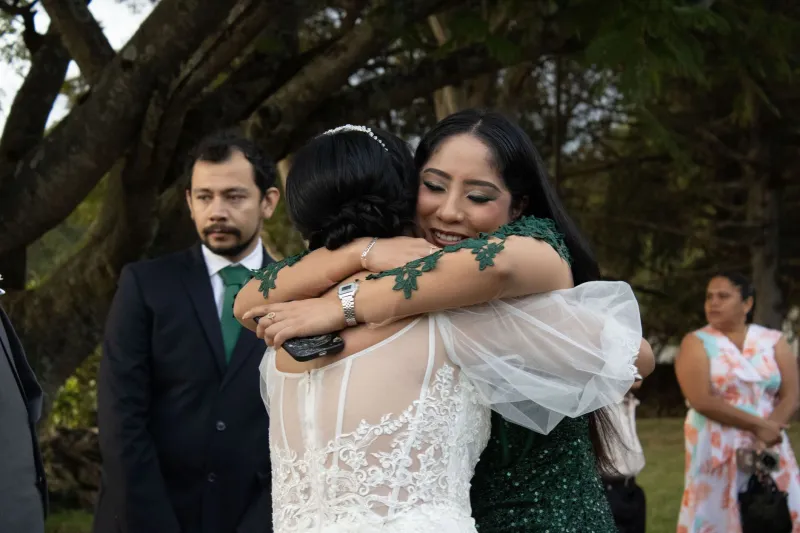
When phones disappear, the frame opens. Hands return to laps, to handkerchiefs, to each other. Faces lift. The photographer no longer competes with a dozen amateur camera operators for the same sightline; the professional becomes the sole witness. That singularity changes the work. It permits longer lenses and quieter positions. It allows the photographer to stay at the back of the aisle and still catch the groom's jaw tightening, the bride's mother pressing a tissue to her mouth, the ring bearer studying his shoes. These are the unguarded expressions that make a wedding album feel like a story rather than a surveillance log.
There is also the matter of light. Phone screens are small, but in a dim ceremony they are bright. They appear in backgrounds as pale rectangles, like windows to nowhere. Removing them removes a class of visual noise that no amount of editing can entirely forgive.
The Photographer's Role Changes
An unplugged ceremony does not reduce the photographer's importance; it clarifies it. The couple has made a public statement that the images they will keep are the ones made by the person they hired. That statement carries trust, and trust changes behavior. Guests stop treating the aisle as a photo opportunity and start treating it as a place to stand and watch. The photographer can move more freely, anticipate more accurately, and remain invisible in a way that is impossible when every third guest is also a camera.
This is also a practical relief. Competing with guest flash is a chronic problem in American weddings, particularly in the evening or in dimly lit venues. An unplugged policy does not eliminate the problem at the reception, where phones will reappear, but it protects the ceremony — the one hour of the day that cannot be re-staged, re-lit, or re-shot.
Practical Guidance for Couples
An unplugged ceremony fails when it is announced at the last moment, with a scolding tone, by a stranger. It succeeds when it is communicated early, framed as a gift, and supported by the people who run the day. The following steps are neither complicated nor expensive.
Say it before the day. Place a short note on the wedding website and, if the budget allows, a small insert in the invitation suite. The language should be warm and specific: 'We invite you to be fully present with us during the ceremony. Please silence and pocket your phones until the reception.' Avoid the word 'ban'; invite instead.
Use signage that matches the room. A single elegantly lettered sign at the entrance is enough. It should be legible from ten feet and placed where guests actually pause — near the guest book, the program table, or the aisle entrance. Two signs are better than five; a corridor of warnings feels punitive.
Give the officiant thirty seconds. The most effective enforcement comes from the person holding the microphone. A brief, gracious request before the processional — 'The couple asks that you keep phones away during the ceremony so you can be here with them' — does more than any sign. It also gives guests permission to relax.
Designate one enforcer. The wedding coordinator, a trusted friend, or a family member should be prepared to approach a guest who ignores the request. The couple should never be that person. The photographer should never be that person.
Offer a transition, not a punishment. Many couples allow phones at the reception and say so explicitly. This reduces resistance. Guests are more willing to pocket a device for twenty minutes if they know the cocktail hour will be unrestricted.
Tell the photographer. Confirm the policy in writing before the wedding. A photographer who knows the ceremony is unplugged can plan positions and lenses accordingly — and can gently remind a guest if necessary without disrupting the scene.
The Larger Argument
The unplugged ceremony is not nostalgia. It is a recognition that attention is the rarest thing a guest can give. A couple who asks for it is not being difficult; they are being clear about what the day is for. The photographs that result are not better because phones are absent. They are better because people are present. And presence, unlike a phone, cannot be edited in later.
At Majestic Imagery, we have photographed ceremonies in cathedrals, barns, courthouse chambers, and backyards. The ones that linger in the album are almost never the ones with the most guests holding cameras. They are the ones where the room went quiet, the aisle stayed clear, and every face turned toward the couple. The phones were not missed. The attention was not.