Heirlooms and Hazards: The Objects That Make or Break a Portrait
Why Objects Speak
A face is not the only thing that tells a story. A watch, a tool, a book, a coat — these are the props of a life, and they carry narrative weight that no lighting setup can manufacture. The best portrait photographers know that an object in the frame is never neutral. It either adds a sentence to the story or subtracts one.
The distinction is not about cost or rarity. A grandfather's watch can be worth less than a new phone and still do more work in a photograph. A worn hammer can outshine a designer chair. What matters is provenance, texture, and intention. The object must belong to the person, not to the set.
Five Objects That Belong
1. An Inherited Watch
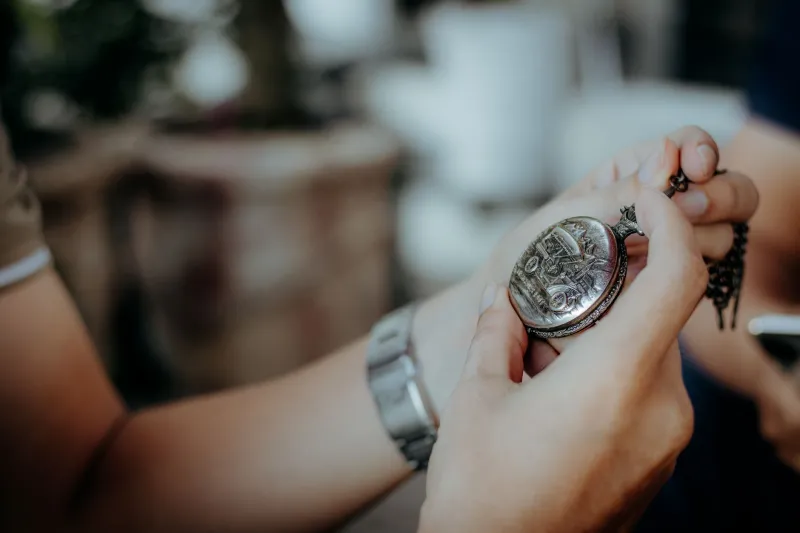
A watch that belonged to a parent or grandparent is one of the most reliable objects in portrait photography. It sits at the wrist, close to the hands, which are already among the most expressive parts of the body. It catches light without demanding it. It implies time, lineage, and mortality without saying a word.
The key is to let it be worn, not displayed. A watch held up to the camera becomes a product shot. A watch on a wrist, slightly turned, with the sleeve pushed back, becomes a detail the viewer discovers. Ask the subject to wear it as they normally would. If it no longer runs, that is not a problem. A stopped watch is still a story.
2. A Working Tool
A carpenter's hammer. A chef's knife. A surgeon's loupe. A farmer's pocketknife. Tools are portraits of labor, and labor is one of the most underused subjects in American portraiture. A tool with a worn handle and a scuffed blade tells the viewer what the subject does and how long they have done it.
The tool should be clean enough to read but not so polished that it looks new. If it is too large for the frame, photograph the hands holding it rather than the object itself. If it is dangerous, keep it closed or sheathed. The point is not to show the tool; the point is to show the relationship between the tool and the person.
3. A Family Book
A book with a cracked spine and marginalia is a portable heirloom. It can be a Bible, a cookbook, a poetry collection, or a child's picture book. The object matters less than the evidence of use: the inscription on the flyleaf, the recipe card tucked inside, the corners turned down by a previous owner.
A book also gives the subject something to do with their hands. This is a practical gift. Nervous subjects often need an occupation, and holding a book is more natural than holding a pose. Open it to a marked page. Let the subject look down. The photograph becomes a scene of reading rather than a portrait of sitting.
4. A Garment With Provenance
A grandfather's overcoat. A mother's wedding veil. A military jacket. A hand-knitted sweater. Clothing carries memory in its fibers, and it photographs beautifully when the texture is allowed to show. Wool, linen, denim, and aged leather all read as texture; polyester reads as sheen.
The garment should fit the subject well enough to be worn, not draped. If it is too fragile, place it over a chair or across the lap. If it is too precious, photograph it on a hanger beside the subject. The goal is presence, not costume. The subject should look like they have permission to wear it, even if they never do.
5. A Handmade Object
A child's drawing. A ceramic bowl. A wooden box. A quilt. A letter. Handmade objects carry the imperfections that make photographs interesting: uneven glaze, crooked stitches, a smudged pencil line. They also signal a life beyond the studio — a family, a hobby, a community.
The object should be small enough to hold or close enough to touch. A quilt can be draped across a lap; a bowl can rest on a table beside the subject; a child's drawing can be pinned to a wall in the background. The mistake is to treat the object as decoration. Treat it as evidence.
Three Objects That Quietly Ruin the Frame
1. The Fake Plant
A fake plant is the most common prop in corporate and event photography, and it is almost always a mistake. It adds no story, no texture, and no connection to the subject. It exists to fill space, and it fills space the way a hold button fills a conversation. Real plants can work; fake plants read as waiting-room decor. If the frame needs green, use a real leaf or remove the plant entirely.
2. The Motivational Sign
A sign that says 'Dream Big' or 'Teamwork' or 'Live Laugh Love' is not a prop; it is a caption. It tells the viewer what to think instead of letting the photograph do the work. It also dates the image instantly. The same is true of branded mugs, slogan T-shirts, and wall decals. If the message is worth communicating, let the subject's face and posture communicate it. If it is not, remove the sign.
3. The Oversized Coffee Mug
A mug can be a fine object in a portrait if it belongs to the subject and is held naturally. The problem is the oversized novelty mug — the one with the company logo, the one that requires two hands, the one that covers half the subject's chest. It becomes the loudest object in the frame and the least interesting. A smaller, well-worn mug is better. A cup and saucer is better still. Or no mug at all.
The Rule of One Hero Object
The most common mistake with props is quantity. A portrait with five meaningful objects is usually a portrait with no meaningful object. The eye needs a hierarchy. Choose one hero object — the watch, the tool, the book — and let everything else recede. Secondary objects can exist, but they should be quiet: a chair, a window, a wall.
Ask the subject one question before the shoot: 'If you had to save one object from your home, what would it be?' The answer is usually the right prop. It is not always photogenic, but it is always true. And in a portrait, truth photographs better than decoration.
At Majestic Imagery, we have photographed subjects holding hammers, watches, letters, and children's drawings. We have also photographed subjects holding fake plants because someone thought the frame needed color. The difference is not subtle. An object with a story makes the subject more legible. An object without one makes the subject disappear behind it.