Paper Remembers What the Cloud Forgets: The Quiet Return of the Heirloom Wedding Album
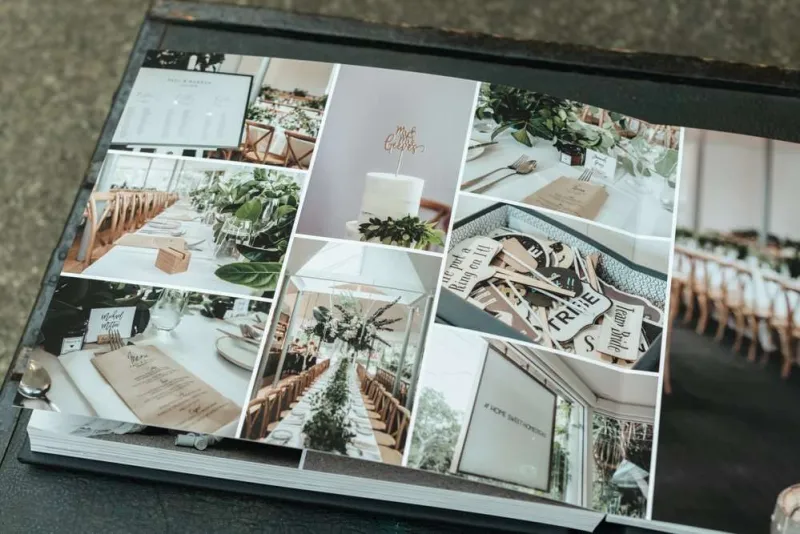
Photo: elegant leather wedding photo album open on table with black and white photographs, via thecoffeetablebookalbums.com
Somewhere in a climate-controlled server farm in Northern Virginia sits a hard drive containing your wedding. Three thousand two hundred images, backed up twice, encrypted, theoretically immortal. And somewhere in a living room in Ohio sits a couple who has not opened that folder since their first anniversary.
This is the paradox of the digital wedding archive: it is always available and never seen. The couples now commissioning leather-bound albums are, ironically, the most digitally native generation in American history — people who have never known a life without the cloud. They are not rejecting technology. They are rejecting the specific kind of forgetting that technology enables.
The Tyranny of the Complete Set
There is a seductive logic to keeping everything. Every candid, every table shot, every slightly soft frame of the first dance — all of it preserved, all of it technically yours. But a complete set is not a story. It is an inventory.
Psychologists who study memory describe something called the "depth of processing" effect: we remember what we engage with slowly and deliberately, not what we scroll past at thumb-speed. A hard drive invites scanning. A book invites sitting. The physical weight of an album in your lap changes the pace at which your brain receives the images, and that pace is precisely where emotional memory forms.
The couples who return to printed albums are not being nostalgic. They are being strategic about their own attention.
The Edit Is the Craft
Here is what surprises clients most when they sit down for an album design session: the hardest work in wedding photography is not capturing the day. It is deciding what the day meant.
A well-built album holds between forty and sixty images. Not four hundred. Not sixty spread across forty spreads with filler. Forty to sixty photographs, each one earning its place, each sequence deliberate — the morning preparations, the vows, the embrace at the reception — arranged so the book reads like a narrative rather than a slideshow.
Consider what this demands. Out of a full day of shooting, the photographer must ask: which single frame tells the story of the father's toast? Which of the two hundred reception candids actually reveals the couple's friendship? Every inclusion is a small act of authorship; every exclusion is a mercy performed on behalf of the viewer.
This is why the album is not a product but a collaboration. When couples arrive at a design session having already flagged their hundred "must-haves," the real conversation begins. Which of these photographs carry the same information? Which ones are you in love with because you remember the moment, and which are strong enough to speak to someone who wasn't there?
That second question is the important one, because of who the album is actually for.
The Reader Who Wasn't Born Yet
A digital archive is addressed to the present. An album is addressed to the future — to children who will one day pull a heavy book off a shelf, and to grandchildren who will understand their family partly through its pages.
File formats decay. Hard drives fail. Passwords die with the people who set them. But a properly bound album on acid-free paper with archival inks has a conservable lifespan measured in generations, the same way the nineteenth-century daguerreotypes in your grandmother's attic survived because someone decided they were worth keeping in a box.
There is also a quieter, more human mechanic at work: the album has a fixed number of pages. Scarcity forces hierarchy. When a book can hold fifty images, each one is a decision, and decisions are what make photographs mean something. The feed, by contrast, is a landfill of equal-weight moments — and equal weight is another way of saying no weight at all.
How to Think About Your Own Album
For couples planning a wedding, a few principles translate directly:
- Think in spreads, not images. A great album reads left to right across two-page openings. Ask your photographer how they sequence, not just how they shoot.
- Insist on the hard conversation. A photographer who agrees to include all ninety of your favorites is not serving you. One who helps you cut to fifty is doing the work you hired them for.
- Choose materials like it matters, because it does. Lay-flat binding, archival paper, genuine leather or linen — these are not luxuries; they are the difference between a book that survives and a book that ages.
- Let the album be the heirloom, not the backup. Keep your digital archive for insurance. Let the printed book do the storytelling.
What the Book Knows
There is a reason the phrase "family album" survived a century of technological upheaval while "family hard drive" never existed. The album was never really about storage. It was about a household's agreement, renewed every time someone opened it, that these moments mattered.
The cloud keeps everything and honors nothing. The book keeps almost nothing and honors all of it. American couples are figuring out that this distinction is not sentimental — it is the entire point.
Every frame tells a legendary story. But a legend requires an editor, a narrative, and a page someone will turn fifty years from now. Choose the fifty. Bind them well.