Before the Vows, a Diagnostic: What One Hour of Portraits Tells Us About Your Wedding
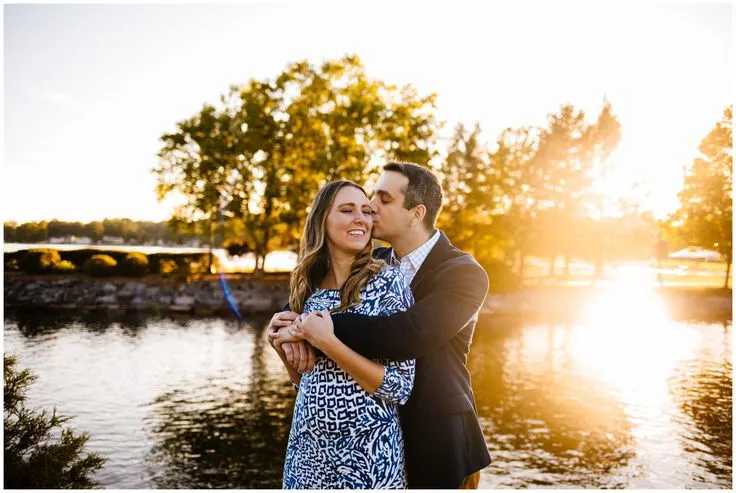
Photo: engaged couple laughing candid portrait session golden hour park, via i.pinimg.com
Every wedding album at Majestic Imagery begins long before the first boutonniere is pinned. It begins, in most cases, in a park in late September light, or on a downtown sidewalk in Chicago, or along a stretch of Oregon coast — wherever a couple agrees to stand in front of a lens for an hour with nothing at stake. That hour is commonly marketed as an engagement session, a courtesy add-on, a chance to 'get comfortable.' All true. But the description undersells what actually happens.
What the engagement session really is, from the studio's side of the camera, is a diagnostic. It is the most information-dense hour in American wedding photography.
What the Lens Learns in Sixty Minutes
Couples arrive at their first session carrying assumptions about themselves. One partner believes they are photogenic. The other believes the opposite with religious conviction. Neither belief survives contact with a professional portrait session intact — and how those beliefs collapse is precisely the data we are after.
Within the first fifteen minutes, an experienced photographer can read a couple's communication style the way a mechanic reads an engine. Do they look to each other before answering a direction? Does one partner defer, and does the other overcorrect? Is the laughter genuine or performed? These are not social observations; they are technical ones. A couple who freezes under direction will need a different wedding-day approach — longer lenses, more distance, candid-first coverage — than a couple who relaxes after two frames.
The session also reveals the physical vocabulary of the relationship. Some couples touch constantly and without prompting. Others require a direction — 'rest your forehead against hers' — to unlock what they do naturally at home. Neither is better. But the wedding photographer who knows this in advance will spend the first look and the first dance capturing, rather than coaxing.
The Freeze, and the Thaw
There is a predictable arc to every engagement session, and we have come to think of it in three movements.
The freeze. The first ten minutes are stiff. Smiles are held too long, hands are uncertain, and every frame is a negotiation between the couple and their own self-consciousness. This is normal, and it is not wasted time — it is calibration.
The thaw. Somewhere around the twenty-minute mark, the performance fatigue sets in. The couple stops arranging themselves and starts simply existing, because arranging oneself is exhausting. This is where the first honest frames appear.
The release. By the final third of the session, most couples have forgotten the camera is present. The images from this stretch are, in our experience, the ones couples frame. And critically, the couple now knows what forgetting the camera feels like. They carry that memory onto the wedding day.
That third movement is the entire argument. An engagement session is not practice standing still; it is rehearsal for the emotional conditions of a wedding — long hours, public attention, a stranger with a camera moving through intimate moments. Couples who have completed the arc once will complete it faster on the day itself.
Why Studios Should Stop Calling It an Add-On
The industry has a habit of pricing the engagement session as a throwaway — a checkbox in the middle tier of a package. This framing does a disservice to both the couple and the final album.
Consider what the session actually produces beyond the images: a shared visual language between photographer and couple. We learn which directions land and which fall flat. We learn whether she squints in backlight, whether he needs a beat before a genuine smile arrives, whether they are most themselves in motion or in stillness. On the wedding day, when the timeline compresses and there are no second chances, that knowledge is the difference between a portrait that documents and a portrait that lands.
From the client's perspective, the economics are equally lopsided. A couple investing five figures in a wedding — and a meaningful portion of that in photography — benefits enormously from a low-stakes trial run. The engagement session is the only opportunity to make every beginner's mistake in advance: the outfit that photographs poorly, the location that reads differently in person, the pose that felt natural and looks stilted. Better to discover these in a park in October than at the altar.
A Recommendation to Couples Planning a Wedding
If you are engaged and your photographer offers a pre-wedding session, reframe what you are buying. You are not purchasing extra photos. You are purchasing the hour that makes every subsequent hour more productive — the rehearsal that lets the actual performance happen without a net.
Choose a location that means something to you, not one that photographs well for strangers. Wear something you would actually wear. Arrive prepared to be slightly awkward, and trust that the awkwardness has a schedule: it leaves on its own, usually within the half hour.
The legendary wedding albums — the ones a couple's grandchildren will pull from a shelf — are not made on the wedding day alone. They are made in the quiet, diagnostic hour that came before, when two people learned how to be seen together, and a photographer learned exactly how to see them.
Every frame tells a story. The engagement session tells us how to tell yours.