One Camera Cannot Be in Two Places: A Solo Shooter's Case for the Second Photographer
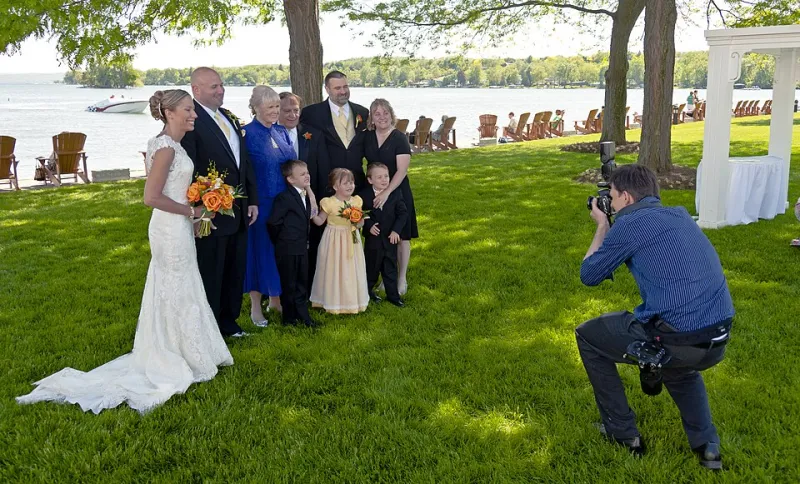
Photo: Daniel Case, CC BY-SA 3.0, via Wikimedia Commons
Let me tell you about the aisle I never saw.
It was a September wedding outside Charlottesville, Virginia — a vineyard ceremony at golden hour, the kind of light photographers claim they'd pay for. The bride's father walked her down forty feet of grass path toward an arch of white roses, and I was where I was supposed to be: at the front, crouched low, framed on her face. What I did not capture was the mother of the groom in the third row, hand pressed over her mouth, quietly weeping. I learned about it later, from the groom's aunt, who asked — kindly, devastatingly — whether I'd gotten "the shot of Karen crying."
I had not. I was one man. One camera cannot be in two places.
The Myth of the Superhuman Solo Shooter
There is a persistent story in the American wedding industry that a sufficiently talented photographer can cover a wedding alone — that skill substitutes for staffing. I believed it for years, and I sold it to couples with confidence. I want to retract that sales pitch now, because the evidence against it accumulated one missed moment at a time.
Consider the arithmetic. A wedding is not one event; it is four or five running concurrently. While the couple takes sunset portraits, the reception room is being transformed by a crew of caterers and florists. While the photographer captures the first dance, someone is filming — I mean photographing — the grandfather watching from the edge of the dance floor. While the primary shooter covers toasts, nobody is covering the reactions at Table 9, where the college roommates are wiping their eyes.
Cinema understood this decades ago. No director shoots a feature with a single camera and calls it complete coverage. There is a B unit. There are inserts. There is a second pair of eyes watching the monitor for what the first pair missed. A wedding is a live, unrepeatable production with a runtime of ten hours and no second takes. Treating it as a one-camera shoot is not minimalism. It is a gamble with someone else's memories.
The Battery Died During the Best Man's Speech
The failures of solo coverage are rarely dramatic. They are small, procedural, and brutal in retrospect.
There was the wedding in Kansas City where my backup body overheated during the summer ceremony, and I swapped lenses at the precise moment the ring bearer bolted down the aisle. There was the cocktail hour in Chicago that exists only in the memories of the guests, because I was busy shooting the couple's private vows and could not be downstairs. There was the toast — the single funniest, most heartfelt best man speech I have ever heard — during which my battery indicator blinked red at minute two. I changed it in a panic behind a pillar and returned to find the room wiping away tears at a punchline I would never see.
None of these were talent failures. They were staffing failures. The equipment worked; the schedule worked; the plan worked. The plan just only had one of me.
What a Second Photographer Actually Buys You
Couples sometimes hear "second shooter" as a line item — a few hundred dollars tacked onto a package. Reframe it as what it is: parallel coverage of a day that only happens once.
A two-person crew means the bride's preparations and the groom's preparations are both documented, not one and a summary. It means wide establishing frames and intimate close-ups of the same ceremony, cut together later like a film edit. It means that when you step away for family formals, your reception is not photographing itself. It means dead batteries, blown flashes, and lost memory cards are inconveniences rather than catastrophes, because redundancy is built into the crew the way it is built into any professional production.
Most importantly, it means the story is complete. A highlight reel shows the couple. A complete story shows the couple and the grandmother dabbing her eyes and the flower girl asleep under the head table. Twenty years from now, those peripheral frames — the ones a solo shooter physically cannot catch — are the ones that will make you weep.
A Checklist Before You Book
If you are evaluating studios, ask direct questions and expect direct answers.
- Will a second photographer be present, and for how many hours? "Available upon request" is not the same as "included."
- Do the lead and second shoot together regularly? A crew that has worked a dozen weddings moves like one; a pair assembled for your date does not.
- Who covers cocktail hour while we do portraits? There should be a named person and a named plan.
- What is the redundancy plan for equipment? Two camera bodies per shooter, minimum, and a clear answer delivered without hesitation.
- Can I see a full gallery, not a highlights reel? Any studio confident in its coverage will show you a complete wedding, start to finish.
I still shoot solo for intimate elopements — eight guests on a Montana mountainside is a one-camera story. But a 150-person wedding is a production, and productions need crews.
I learned that from Karen, who cried beautifully in a frame that does not exist. Do not let your wedding's most honest moment be the one nobody was there to catch.