Every Room Is a Set: Auditing the Places You Already Own

Photo: Benno Rothenberg, CC BY 4.0, via Wikimedia Commons
Most people believe a great photograph happens in a great place. A mountaintop. A studio. A rented loft with exposed beams and a borrowed view. This belief costs clients money and costs photographs their truth. The reality is less romantic and far more useful: the environment in a portrait is never scenery. It is a character with speaking lines, and it is talking about you whether you have listened to it or not.
The Environment Is a Witness
Consider what a plain office wall actually says. A blank expanse of contractor-grade paint whispers that nothing important happens here — hardly the message an executive wants attached to a leadership portrait. A backyard shot at eye level, lawn chair and garden hose in frame, tells a story of casual comfort, but told carelessly it reads as an absence of intention. A downtown sidewalk, shot wide, buries its subject beneath parking meters and foot traffic.
None of these places is wrong. All of them, unexamined, are unedited. The craft of location work begins with the assumption that every setting is making an argument, and the photographer's job is to decide whether to let it speak, silence it, or give it a better line.
The Walk-Through: A Five-Point Audit
Before any session at Majestic Imagery, we conduct what we call a backdrop audit — a disciplined walk-through of the spaces a client already owns or frequents. It requires no travel and no permits. It requires only that you look at the familiar with unfamiliar eyes.
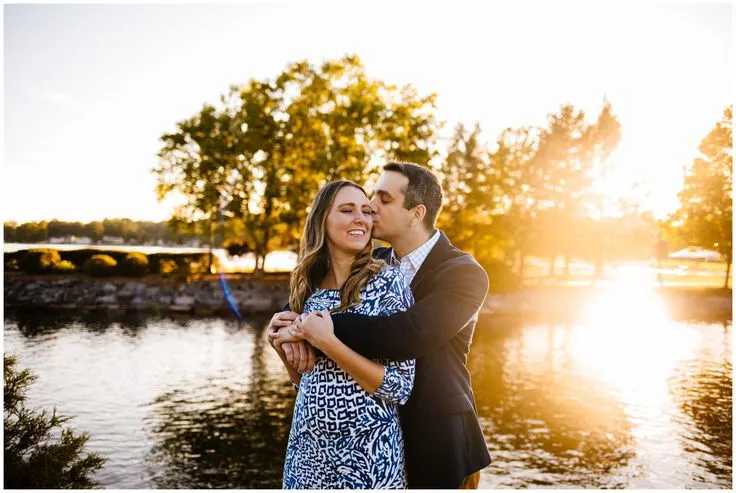
First, the light. Stand in each candidate space at the hour you would actually be photographed there. Watch where the sun enters and where it fails to. A south-facing living room window in the late afternoon is a softbox you did not have to rent. A covered porch facing west can deliver a golden-hour gradient that studios charge by the hour to imitate.
Second, the depth. A backdrop needs distance to breathe. A wall two feet behind your shoulders compresses the frame and flattens the story. A hallway that recedes, a staircase that descends, a street that curves out of sight — these give the eye somewhere to travel, and travel is what makes an image feel cinematic rather than documentary.
Third, the clutter. Every space carries its litter: the thermostat, the outlet, the exit sign, the neighbor's trash bin. The audit is not about cleaning the location but about cataloging its noise so the frame can exclude it. A three-quarter turn of the body, a camera angle two feet lower, and an entire suburban garage becomes an anonymous slab of texture.
Fourth, the texture. Painted drywall says little. Brick, weathered wood, tin ceilings, and glass say a great deal. American towns are full of texture that photographs like expensive set design — the limestone of a county courthouse, the painted signage of a hundred-year-old hardware store, the corrugated steel of a grain elevator on the edge of town.
Fifth, the meaning. This is the audit's final and most important question: does this place belong to your story? A portrait made in the diner where a couple had their first date carries a charge no rented backdrop can duplicate. A founder photographed at the loading dock where the business shipped its first order has an heirloom, not just an image.
Case Study: The Driveway Session
A recent client, a second-generation manufacturer in the Midwest, assumed his portrait required a studio three hours away. The audit found something better at the end of his own driveway: a late-day sun raking across the bay door of his workshop, casting long parallel shadows across poured concrete. Shot at the right hour, from a low angle, with the workshop's interior lamps burning warm behind him, the image reads as an executive portrait from a magazine feature. The location cost nothing. The intention cost everything.
The Discipline of Seeing
The backdrop audit is ultimately a habit of attention, and it can be practiced by anyone. Walk your own rooms at your own golden hour. Notice where light lands and where it refuses. Ask what each wall, each window, each stretch of hometown brick would say if it could testify.
Because it will testify. The only question is whether you will have chosen its words.