The End of the Handshake Portrait: Why America's Corner Offices Are Going Cinematic
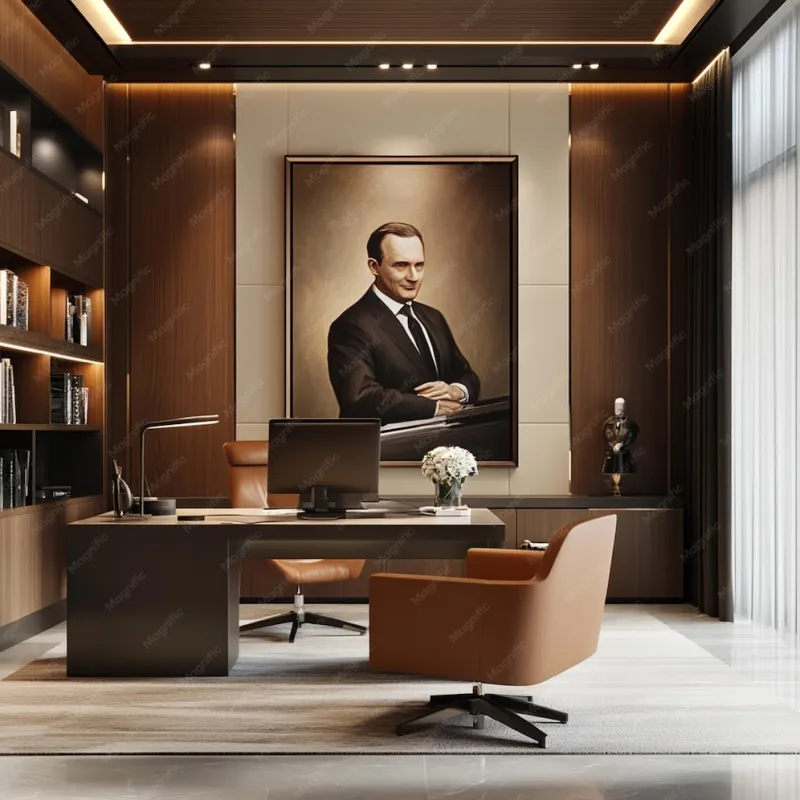
Photo: dramatic environmental portrait of CEO in modern office with window light, via img.freepik.com
There was a time — not long ago, and not yet fully over — when the American chief executive was photographed the same way in every boardroom from Chicago to Charlotte: seated at the edge of a desk, hands loosely clasped, torso angled forty-five degrees toward the camera, smile calibrated to a setting between 'approachable' and 'plausible deniability.' The portrait said nothing about the person. It said everything about the era that produced it.
That era is ending. Walk the halls of any Fortune 500 communications department today and you will hear a phrase that would have sounded strange a decade ago: photography as brand strategy. The portrait is no longer a formality appended to a press release. It is the first paragraph of the story a company tells about itself.
The Crop That Changed Everything
The shift has a technical name in editorial circles — the environmental portrait — and a simpler one everywhere else: the boardroom crop. Instead of isolating the subject against a seamless gray backdrop, the photographer works inside the subject's actual world. The frame widens. The architecture speaks. Light falls the way light actually falls in a real room, at a real hour, on a real person who runs a real company.
The result looks less like a badge photo and more like the opening frame of a documentary. And audiences, it turns out, can feel the difference before they can articulate it.
Three Executives, Three Reckonings
Consider a Midwestern logistics CEO — call her the former keeper of the classic desk-perch portrait — who spent years watching her headshot circulate through trade publications looking, in her own words, 'like a substitute teacher's yearbook photo.' When her comms team commissioned an environmental shoot, the photographer arrived at 6:40 a.m. to catch window light across the operations floor. The resulting image — her silhouette against a wall of glass, a distribution center blurred and humming behind her — ran alongside a feature in a national business outlet. Her team noticed something odd: reporters began quoting the photograph. It anchored the story's tone before a single sentence was read.
A second case: a fintech founder in Austin who had built his brand on transparency but photographed like a stock-photo handshake. His LinkedIn engagement, he admits, was 'in the low single digits, and I mean that generously.' A cinematic re-shoot — dramatic side light, negative space, an expression that suggested a man mid-thought rather than mid-pose — changed the arithmetic. His posts featuring the new portraits drew engagement numbers he describes as 'an order of magnitude' higher. Investors noticed. One later told him the portrait was 'the first thing that made the deck feel real.'
The third executive, a hospital-system president in the Northeast, resisted the entire premise. She regarded dramatic portraiture as vanity. What changed her mind was investor-facing material: the annual report's old portrait, shot against a wrinkled backdrop in a rented conference room, sat beside pages of polished design like a missing tooth. The new portrait — shot in the hospital atrium at golden hour, staff moving softly out of focus behind her — did not merely look better. It communicated stewardship. It said the institution had nothing to hide and everything to show.
What the Communications Teams Already Know
The pattern across these three stories is not coincidence. It is a quiet consensus forming inside American communications departments: the executive portrait is the most-viewed image a company produces, and for years it was the least-considered one.
Press coverage, LinkedIn presence, investor decks, earnings-day coverage, the About page that journalists screenshot into their drafts — all of it draws from the same small pool of imagery. When that pool is shallow, every downstream asset inherits the shallowness. When it is deep and cinematic, the opposite occurs. The photograph stops being decoration and becomes argument.
There is also a candid talent-market dimension. Executive candidates research leadership the way consumers research brands. A leadership page populated with genuine, considered portraiture signals a culture that takes its own story seriously. A grid of identical cropped headshots signals the opposite — that the company photographs its people the way it photographs its copiers.
The Case for Making the Portrait Matter Again
None of this requires a chief executive to become a celebrity. It requires only the recognition that a portrait is a text — the first one most audiences ever read. The handshake pose was a text too. It said: we are conventional, and we are comfortable being conventional. Perhaps that was a defensible message in a calmer decade. It is a costly one now, when attention is scarce and every impression competes.
The corner-office portrait is not being retired because executives grew vain. It is being retired because executives grew literate. They learned to read images the way they read balance sheets — for what they reveal, and for what they cost.
The boardroom crop, done properly, is not a photograph of a person. It is a photograph of authority at ease with itself, standing in the world it built. That is a legendary frame. It deserves to be made deliberately.