The Handshake Happens Before the Handshake: Your Headshots Are Speaking for You
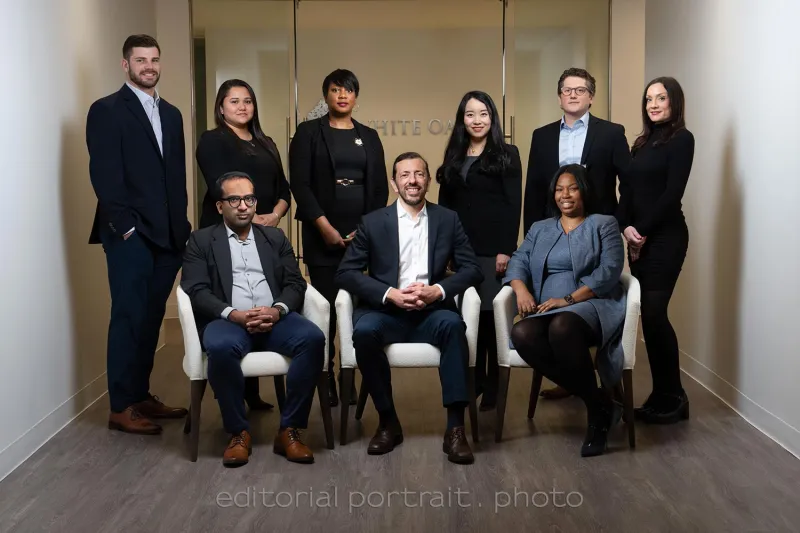
Photo: professional editorial corporate team portrait dramatic lighting studio, via neilvn.com
Consider the modern buying journey. A prospect hears your company's name in a meeting, on a podcast, in a proposal email. What is the very next thing they do? They look you up. They land on your 'About' page or your LinkedIn profile, and there — before a single word of your copy is read — your team is standing in front of them.
That moment is a handshake. And too many American businesses are showing up to it with a limp one.
The Uniform Problem
We call it the gray-backdrop syndrome: the same soft, even lighting, the same slightly off-center crop, the same forced corporate smile, repeated across an entire leadership team. It was safe in 2005. Today it reads as something else entirely — a signal that a company approaches its own presentation with the same energy it applies to everything else: adequate.
Clients don't articulate this. They feel it. When a firm's imagery is generic, the assumption — fair or not — is that the work is generic too. When the imagery is deliberate, editorial, unmistakably considered, the assumption flips. Craft is judged before competence ever gets a chance to speak.
Perceived Value Is Built in Pixels
There is a reason luxury brands photograph their watches on marble rather than manila. Presentation is positioning. A law firm in Chicago that replaced its clipped-out, white-background headshots with dramatic, window-lit portraits reported partners being asked, unprompted, 'Who did your photography?' in client meetings. That question is not about photography. It is about the firm.
The pattern repeats across industries. A regional architecture practice in Denver refreshed its team portraits with environmental shots — leaders photographed in the spaces they design, with directional light and honest expressions. Within a quarter, the practice noted stronger engagement on proposals and a measurable uptick in qualified inquiries arriving through its website. Nothing about the firm's actual work had changed. The framing had.
What Editorial Portraiture Actually Does
A distinctive team portrait accomplishes three things a stock-standard headshot cannot:
- It establishes hierarchy without a title. Lighting, composition, and posture communicate seniority and confidence before a bio is read.
- It signals investment. Companies that spend thoughtfully on how they present their people are presumed to spend thoughtfully on how they serve their clients.
- It creates memorability. In a feed of two hundred identical headshots, the portrait with character is the one that gets remembered — and remembered is what converts.
The Objection, Answered
The pushback we hear most often is cost. 'They're just headshots.' But that framing gets the math backwards. The About page is among the most-visited pages on nearly every B2B website in the country. Pricing that traffic's first impression at bargain-basement rates is not thrift; it is a quiet leak in the brand.
The other objection is consistency: 'What if one person looks better than another?' That is precisely the craft problem a professional studio solves. Editorial portraiture is not flattery for a lucky few — it is a system that renders every member of a team at their most credible.
The Verdict
Your company's story is told in a hundred places you don't control. Your portraits are one of the few you do. Treat them as the opening statement of every pitch, every proposal, every first impression — because that is what they are.
The handshake happens before the handshake. Make sure your team shows up for it.